
Ono no Komachi
Japan's Legendary Poet
It’s hard to know where to start with the women poets of the Heian era; there are so many that deserve recognition and putting one of them first might seem to slight the rest of some way. I certainly don’t want to do that, but as I have a begin with someone, I’m going to go with Ono no Komachi. She’s one of the best known, was pivotal in the history of Japanese poetry and she, perhaps alone among Japanese poets, became a legend. Even today, she’s as important figure in Japan and she remains controversial. In some ways (as I briefly mentioned before), she kind of reminds me of Helen (of Troy) in our tradition. Like Helen, some people admire and even revere her; others think of her as cruel and heartless in her youth or maybe as a “fallen woman” for her “licentious” ways who got her “just desserts” in the end.
In fact, little is known about her life, so making up things about her is all to easy. Whatever the truth of her life is, she’s a symbol (as Helen is) how an exceptionally beautiful and extraordinarily talented woman disrupts our world, then and now.
Now, I’d like to introduce you to her.
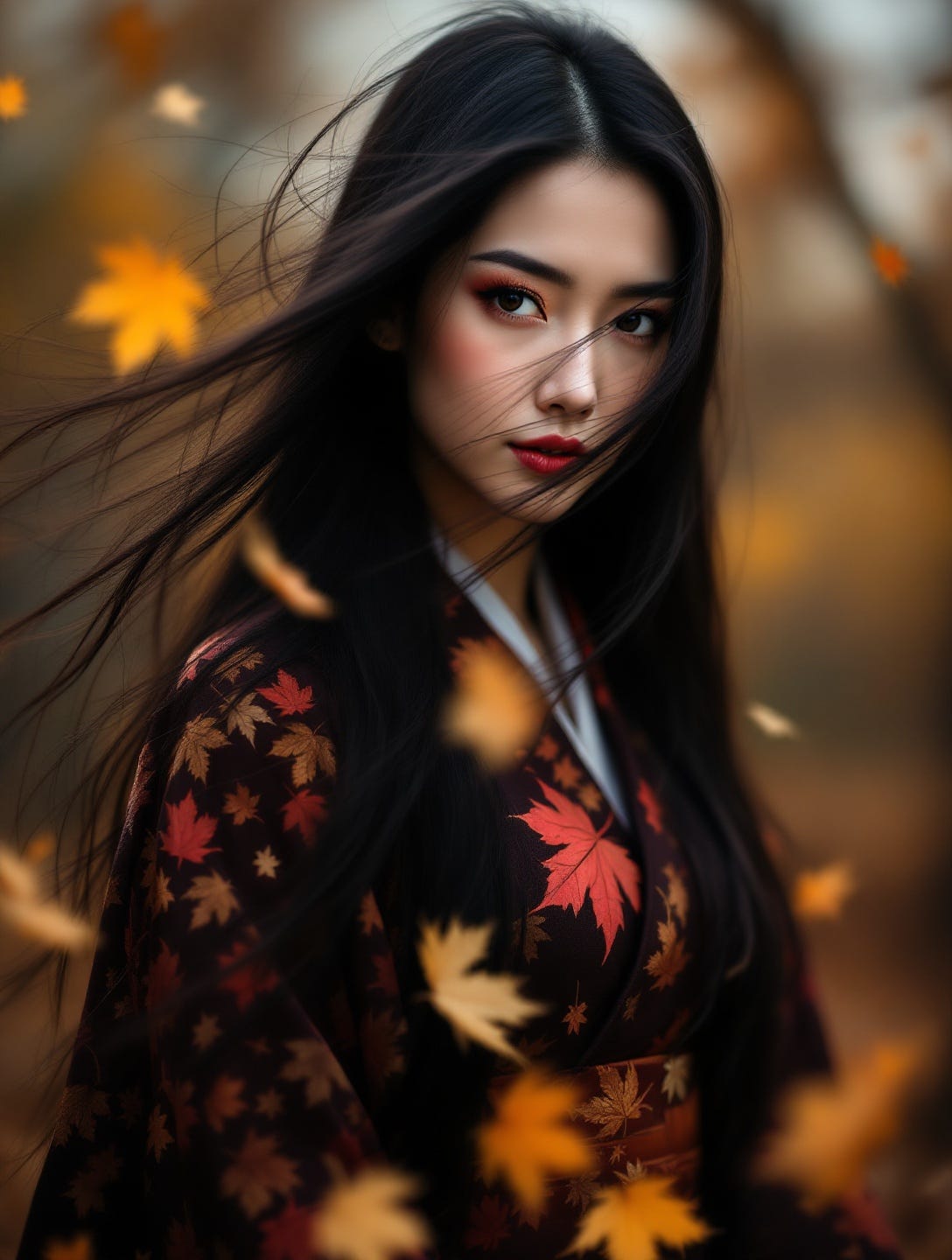
Ono no Komachi was born around 834 and became a lady of the imperial court in the mid-9th century. She established herself as a brilliant poet early on, her work being famed for its passion, philosophical depth, and the excellence of its composition. Her poems are known for their artistic complexity, which is nearly impossible to render in English, and for an intensity that is unsurpassed in Japanese poetry. All these things had a major impact on how Japanese poetry was composed and viewed ever since.
She was famous as a great beauty as well as a poet, and became a legendary figure soon after her death, being named one of the “Six Poetic Geniuses” by Ki no Tsuriyuki’s preface to the Kokinshu—the only woman included in his list. She is also included as one of the “Thirty-six Poetic Geniuses” (translated various ways; I pick this one) as well as one of the “Thirty-six Female Poetic Geniuses,” both canonical lists for Japan’s greatest poets.
We know little about her life. She was of the minor nobility, may have had a child and her legend assigned her a bad end; haggard, half-mad and impoverished. She’s been depicted as heartless, fickle lover who toyed with those who sought her affections. One story (which I think may have Chinese origins) is that she told a young man she’d sleep with him only after he visited her for 100 nights in a row and spent the whole of each night waiting alone outside her window.
The young man persevered, spent 99 nights doing as she demanded, but on the 100th night, he died. If I remember correctly, in some versions of her tale (told in some famous Noh plays, among other forms), his ghost comes back to haunt her in her old age, when she ugly and alone.
Much of her surviving poetry deals with the pain of unrequited love, but gives no hint who the loved one might be. Her poems, of which only about 100 survive, and the few facts available, have led to much speculation about this person’s identity; rumors suggest she had an affair with the famous poet Ariwara no Narihira. All we can say is that her sad end is just as likely as not to be the work of moralists who wished to “pay her back” for her beauty and brilliance, and we are justified in hoping she found solace.1
To try to give some idea of why Ono no Komachi is so famous and revered as a poet, I’m going to say a little about one of her most famous poems. (I quoted it in this post.) First, I want to present the English transliteration of it (the romaji).
   Hana no iro wa
      utsuri ni keri na
      itazura ni
  wa ga mi yo ni furu
       nagame seshi ma ni
Take a moment and let those syllables run softly and slowly across your tongue as you whisper them. As your breath carries them through your lips, focus on how they feel.
Feel it? There’s music there. Soft, poignant; longing mingled with acquiesce—the shadow of a delicate, cherished ache. You don’t need to understand Japanese to get the meaning. It settles in your chest; the echo of that ache.
That’s the essence of her poem, which we don’t need translation for. But what does it mean—those syllables?
Below are five translations of her poem (out of many), to give an idea of how people have tried to convey it in English. This should provide some idea of why translating Heian poetry is so challenging.
A life in vain.
My looks, talents faded
like these cherry blossoms
paling in the endless rains
that I gaze out upon, alone. [From Wikipedia]
I have loved in vain
and now my beauty fades
like these cherry blossoms
paling in the long rains of spring
that I gaze out upon alone. [Peter MacMillan, from his translation of One Hundred Poets, One Poem Each]
As certain as color
passes from the petal,
irrevocable as flesh,
the gazing eye falls through the world. [Kenneth Rexroth, from his collection of translated poems, One Hundred Poems from the Japanese]
While watching
the long rains falling on this world
my heart, too, fades
with the unseen color
of the spring flowers. [Jane Hirshfield, The Ink Dark Moon: love poems by Ono no Komachi and Izumi Shikibu.]
Alas, flowers’ color
fades unseen
while I watch
the long rains fall on this world
as my heart, too, fades... [my own version]
These translations each try to express the sense of loss and longing of a life that is nearing it end. The first two translations emphasize the loss of youth and beauty, fading talents and failed affairs (“loved in vain”). Hirshfield’s translation, which I followed and adapted, is broader, encompassing a long storied life, but one that is ending in regret.
As Hirshfield says, Komachi used “interwoven images of time passing” and in the imagery of flowers fading before they can seen, Hirshfield detects a poignant lament about love that was either unrequited or balked by circumstance. Just as the rain has leached the color—that is, the beauty—of these flowers without them being viewed, so has the poet grown old without being together with the one she loves. Or as she puts it:
“…the poet is growing old as it rains, she is watching her own aging, the long rains are inexorably falling. In a mingling of subjective and objective worlds, the poet looks out her window on a rain which causes flowers to fade without being viewed, as she herself grows older without being known by her lover.”
The key to the poem are the pivot-words huru and nagame, which mean both aging/falling and long rains/watching, respectively. MacMillan gives an even more detailed breakdown of the various meanings, or shades of meaning, that Komachi’s words have. Put it all together and we begin to get a sense of how much she able to convey in 31 syllables.
I tried (inadequately, I’m sure) to compress all this into the shortest English passage I could think of. I came up with this:
Alas, my talents and charms/beauty/sexuality/sensuality have faded uselessly like the unseen color of [spring] flowers and come to nothing. While I watch the long rains fall on this world, I am lost in thought about my past romances/sexual relationships/youth.
Ok, hardly poetry. And it doesn’t do real justice to the “heart full of sorrow and deep feeling” (Hirshfield’s words) of Komachi’s poem. In this regard, I’ll note that “heart” doesn’t appear in the poem and other translators don’t use the word. I used it, and I feel Hirshfield used it, because “heart” is the closest thing we have in English to an appropriate pivot word, implying the heart of what truly matters as well as love and romance and the seat of our most profound emotions. In this sense, all that Komachi is regretting—all that is fading in the rain—is her heart.
Implicit in this is the awareness that time (like the long rains) leaches away the pleasures, beauty, talents and charms of youth. As Hirshfield says, the core of the poem is the knowledge that life is fleeting, but youth (and all that it offers) is even more fleeting.
But not all scholars agree. In his introduction to One Hundred Poets, One Poem Each, Peter MacMillan gives a radically different interpretation. It’s best to quote him directly. He says: “... in this poem Ono no Komachi employs the classical device of negation to produce what is ostensibly a lament for her fading beauty and talents.” Then he goes on to say:
“… in other words the poet is saying something like this: I am growing old and am less beautiful than I once was. Maybe you superficial, especially male!, readers will no longer find me attractive, but if you have a minimum of discernment, you will be able to see under my disguise and realize that the sadness of life has only sharpened my genius. Fade away, those of you who can only see the surface; and even those of you who can see beyond the surface, approach gingerly, for the profundity of my emotion has made me as formidable as ever.”
In essence, Hirshfield is saying that Komachi is making a poignant statement full of “sorrow and deep feeling,” while MacMillan believes she is giving her readers the finger.
Who’s closer to the truth? It’s impossible to say. That’s part of the genius of Ono no Komachi in a nutshell: she’s still able to confound us, more than a thousand years after her death. And she did with 31 syllables.
That is one on the many reasons I love her work and Heian poetry in general. To explore it is to forever find things beautiful and new and unexpected; to (quoting Hirshfield one last time) “reach down to the very bedrock of our lives.”
I don’t think there can be anything more important.
Thank you for reading. That is also massively important to me and deeply appreciated. feel free to leave your thoughts below.
As we’ll see with other genius women of this era, this sort of thing is unfortunately typical. Of course, it’s far from limited to Japan. The ancients revered Sappho as the 10th Muse, but assigned her as sad end too: committing suicide over a guy who rejected her. They did the same thing to Queen Artemisia of Halicarnassus—the brilliant woman admiral who would have changed history of she’d been listened to—and in the same way, for the same reason, and in the same place. It’s a theme.